The Propaganda Game [2015)

Here is a perfect documentary.

It teeters for a second.

Early.

Because it shows two of the most vile, reprehensible propagandists in the world.

Susan Rice and Barack Obama.

But it lets them speak.

The film lets Rice and Obama make fools of themselves.

[and it doesn’t take these two idiots long]

Then we are immersed in a richness of inquiry which befits the home country of our director.

Spain.

But Álvaro Longoria’s film is about a wholly different place.

North Korea.

I was lucky enough once to visit Mr. Longoria’s hometown of Santander.

Though I was not there long, I found it odd that we (me and my traveling companions) boarded our plane on the runway.

A Boeing 737, I believe it was.

So we are talking about perhaps 200 people.

On a runway in Spain.

With a little control tower.

I must admit.

The operation was not heartening.

But then again, I’ve taken a propeller plane from Sacramento to San Francisco.

The world likes to think of America as filthy rich.

But we still have propeller planes for some of our shorter routes.

Flying over San Francisco Bay in a propeller plane wasn’t exactly my idea of relaxation either.

But so then…what do we think of North Korea?

If we listen to people like Susan Rice and Barack Obama (neither of whom, categorically, can be trusted), then we are to shudder at the thought of the DPRK.

Well, our director Mr. Longoria has given the most fair, measured approach to a very controversial subject.

And his final product (the film) is so much the better for it.

To wit, Mr. Longoria does not presume to think for his viewers.

He lets you decide.

If you are looking for bias in this film, you will have to look pretty hard.

Perhaps, you will reason, Mr. Longoria is a Spanish leftist and therefore he gives North Korea the benefit of the doubt.

On the contrary, one might reason that the director is a very (VERY) savvy propagandist himself…and therefore, his documentary is largely an exercise in reverse psychology.

I must admit.

When I heard the voices of Rice and Obama, my internal monologue of opprobrium almost caused me to lose my lunch.

But I stuck with it.

And I’m so glad I did.

What is at issue in this film, and in the frozen conflict zone of which North Korea is half, is the discipline/technique/art of propaganda.

If you are very dumb (and I doubt you are, as you are reading this illustrious blog), you will believe everything you hear about North Korea.

You will believe CNN.

You will believe Martha Raddatz.

You will believe George Stephanopoulos.

To call these two “presstitutes” is really being too kind.

They make Rice and Obama look like saints.

Those of the Raddatz/Stephanopoulos ilk in the United States journalistic community are really worthless individuals.

Mostly because they have ceased to BE individuals.

They aren’t even drones.

They are more like little Lego pieces of poisonous honeycomb.

Inhuman.

But they’re not alone.

Throw in Diane Sawyer.

Actually (and I’ll throw the lefties a bone), throw in Bill O’Reilly.

All of these journalists are generally less than nothing when it comes to their global contributions.

And so it only makes the case of the DPRK stronger (for better or worse) when such née-individuals (including emasculated presstitutes) insult North Korea.

And so it is very clear that North Korea is the target of an immense amount of propaganda.

HOWEVER,

the DPRK seems itself to be quite prodigious in the art of manipulative communication.

Or, propaganda.

So our director lets the two sides go at it.

It’s almost like two Charlie Brown schoolteachers (Othmars both) having a verbal altercation.

The West:  “Blah blah blah blah HUMAN RIGHTS blah!”

North Korea:  “Blah blah blah blah IMPERIALISTS blah.”

We must credit North Korea with restraint.

The people.

Polite.

Keep in mind, this is a focus on the people.

What kind of people live in North Korea?

[well, Koreans…obviously]

Adults, children…male, female…

And so the cynic will cry “Potemkin village” very early on in this one.

But it is worth watching till the end.

Most intriguing is the figure Alejandro Cao de Benós de Les y Pérez.

Here’s an idealist if ever there was one.

But that’s what we must remember about North Korea.

It is a country of extreme idealism.

Let me frame it with slightly different diction.

It is a country of immense idealism.

[ah…we even got some alliteration there!]

Mr. Cao is, or was, Spanish.

Now he is a North Korean.

He is a spokesman for the DPRK.

As we say here in the West, he’s “all in”.

He digs their chili.

He’s drinking the Kool-Aid.

We want some of whatever he’s smoking.

[you get the picture]

But I must say…

Mr. Cao is an extremely (immensely) articulate individual.

To hear him tell it (and he does so with genuine conviction), North Korea is the last bastion of communism.

China has sold out to market forces (capitalism).

The Soviet Union sold out Stalin (Cao actually makes this claim).

[and, he asserts, China sold out Mao]

Vietnam is now thoroughly capitalist.

[that might be a direct quote]

So does Mr. Cao have a point?

Well, perhaps he does.

But there are doubtless few self-respecting communists [more to this sentence after brackets] who would hold up North Korea as a beacon of socialist governance.

Communist, socialist, Trotskyist…

It all begins to run together for us heathen imperialists.

Ah!

There’s that other buzz word.

Imperialism.

Indeed, if you look at the U.S. military bases in South Korea and Japan (which this documentary illustrates as a sort of “ring of fire” [pun intended]), the imperialism charge is not without evidence.

But this is really the quintessence of what Nick Tosches calls “intellectual parlor games”.

Meaning, we could be here all day.

I’m at nearly a thousand words (and so are you, if you’re still with me) and I haven’t even begun to truly scratch the surface of the imbroglio that is the 38th parallel.

North latitude.

Simply put, the U.S. has a vested interest in creating and propagating propaganda about North Korea.

[which does not mean that all of the reportage is made-up…indeed, the best propaganda has a kernel or modicum of truth…sometimes even a heaping spoonful…North Korea certainly does not seem to have the whole “public relations” thing down yet]

And conversely, North Korea has a vested interest in creating and propagating (mostly for internal, domestic purposes) propaganda about the United States and capitalist economies in general.

[and granted…the United States has done some incredibly daft stuff…the likes of which could be spun into a thousand tales of horror for 10,000 years]

What really complicates matters are nuclear weapons.

North Korea, we are told, has twenty (OH MY GOD!  20!!!) nuclear weapons.

The United States has sixty-eight-hundred (6,800) nuclear warheads in various states of readiness.

I hate to sound like Ted Turner (and it’s sad when Mr. Turner becomes a voice of reason), but there seems to be a rather glaring discrepancy there.

Oh!

But one side is responsible (I’ll let you guess) and the other side is reckless (guess again).

Of course, nuclear weapons have never been used in war…except by the United States.

Twice.

And so every society has its propaganda.

I will never feel very good that my country nuked two Japanese cities.

Somewhere between approx. 125,000 and 250,000 Japanese people (at least half of them civilians) were vaporized and/or bombarded with lethal radiation by Fat Man and Little Boy.

I know that the U.S. Department of Defense (then known as the Department of War and Department of the Navy, respectively) isn’t selling Girl Scout cookies.

But Harry S. Truman’s “display” on live targets is a rather hard pill to swallow.

We are supposed to think statistically.

Think of how many lives we saved (by, counterintuitively, squelching perhaps a quarter million OTHER souls).

I guess maybe after six years of war, we were insane.

They say it only takes 100 days.

Of warfare.

Any man (or woman).

No matter how mentally strong.

Literally insane.

Beyond that point.

But we were talking about North Korea…

Mr. Longoria is more of a scientist than me.

Our director, Mr. Longoria.

He meditates on the problem.

He is not rash.

Granted, his access to the “hermit kingdom” compels him to be open-minded (if only for the duration of his stay [and in strictly “apparent” diplomacy]).

It seems evident to me that Álvaro Longoria is a very formidable filmmaker.

I wonder what he would have made of our recent American election?

[when Trump supporters learned to hate Hillary…and Hillary supporters learned to hate Trump]

In retrospect, the United States has just been the battlefield of an immense propaganda war.

The winner (for the time-being) was and is Donald Trump.

But the war was so ugly that things are still not back to “normal” in the USA.

Perhaps they never will be again.

And that is also the lesson of The Propaganda Game.

This substitutes for bullets when you cannot shoot.

When destruction is mutually-assured, colder, icier methods prevail.

Sneaking, surreptitious oozing of lies and falsehoods.

All’s fair in war and love, they say.

And “close enough” only counts in horseshoes and hand grenades.

“They” say that too.

“They” say a lot of things.

Indeed, “they” are the most quotable group around.

Now, if we only knew who “they” were…

-PD
Tokyo Fiancée [2014)

I have been absent.

Because work.

Not working, but looking.

Labor.

Jobs.

Money.

Healthcare.

I have been absent because anxiety.

Always.

But better.

Walking.

Stretching.

Exercise.

Rest.

Time.

And now the cosmos brings me a perfect film.

Because Pauline Étienne.

Actress full of joy.

But the grand auteur is Stefan Liberski.

Every color.

Every gesture.

You must pinstripe, tuck up your hair you haven’t.

You must primary color.

Yellow and red.  Made in U.S.A.

“You must fall in love with me,” says Pauline Étienne.

“I command you.”

[she continues]

And of all the girls in the world, the Belgians and Finnish are the most diabolically beautiful on film.

Godard said the Swiss.

Clear bias.

And so we have a Belgian film set in Japan.

If we try hard, we can hear Debussy.  Estampes…

Pagodes…

Sado Island… […]

To dream in the rain.

Cross the bridge.

And the river steams.

You seek a nectarine.

A noisy kiss.

Pauline Étienne.

Buttermilk legs joy rollerskate skinny.

Was taken from Salinger.

Joyce said spittoon.

As cuspidor.

The most beautiful word.

Girl.

Some films, books so good…too much to handle.

My wish.

To marry.

To have that happiness.

A mere handful of fives away from Valentine’s.

When Colombia and Ecuador will be pumping out roses for Starbuckers.

All along.

They said that sex was uncouth.

Or resorted to farm metaphors of propagating species.

But.

They couldn’t talk about love.

Excitement.

When your breath is stolen by a cold kiss.

In the autumn.

Winter.

And yet warmth from optimism.

But we must get on to the little back alleys of Tokyo.

And for a moment stop this dream.

To be born.

In Japan.

Of Belgian parents.

Does not a Japanese make.

I can suck the life out of Auden.

Elliptical.

Though I thought I was aping Céline.

But director Stefan Liberski is aping no one.

personne

We must mention the author and not the auteur, though in French there is no difference (save for the milieu of cinema).

And she gives us a fantastic story.

Amélie Nothomb.

No thumb.

Better than “all thumbs”.

Rhombus.

Can you suck on a diamond lozenge from a ring?

Lots of sucking.

But that’s the aw-kward + loneliness which makes a great film.

This one just happens to pull in Belgique and Nippon to boot.

It depends.

On her yellow socks.

On her haircut.

Pauline Étienne.

On sweater with blue stripes.

Like Edward Hopper did the cinematography.

But the Francophones have it figured out.

Every trick.

Which is to say.

No tricks.

Just emotion.

Realism.

No bullshit.

Embrace the history of film.

Compare and contrast.

What works?  What doesn’t?

What speaks to you?  How does a culture (French, par exemple) see a film?

Answer:  it doesn’t fucking matter.

What matters is the overflowing love and romance which infuses Tokyo Fiancée.

Only thing Lars von Trier ever did well was film Kirsten Dunst in the nude.

Stefan Liberski surpasses von Trier’s entire oeuvre with this one film.

Yes, I’m polemic as fuck!

I’ll take François Truffaut (the film critic) and a bottle of white wine for my friend.

I like red.

And Guy Debord.

I’ll take chances.

Damn.

I have taken so many fucking chances.

But we get scared.

Worn out.

Frightened by inexperience.

All of that is in the film.

Taichi Inoue is really sweet as Rinri.

But I keep coming back to Pauline Étienne.

She has cast a spell over me.

And I must ask:  who does she signify?

Forget the character name.

For each sad soul who dreams their way to the end.

She represents someone.

Fondue.

Teeth which nave never left the village.

New born yellow as unripe baby corn.

On the farm.

Maybe.

A different register (accent?) of French in Belgium.

Immediately recognizable to a Parisian.

And with little modesty lambasted as yokel French.

But perhaps the Belgians and Quebecois have this in common.

A cause for solidarity.

And add in the Swiss…with their weird counting and smoky lisp.

Is it?

Tokyo Fiancée hits harder than La Religieuse (2013) because it is not stilted nor steeped in period costumes.

Just tell a fucking story, we say.

Pauline Étienne.  Born in Ixelles.

How could anyone from such a place be any less than ravishing?

When we think in microcosm.

If we only know one Indian person.

They become India.

For us.

And complicate this with a multicultural relationship.

That is the gasoline of Tokyo Fiancée.

It is clean.  And genius.  Like Magritte.

A bowler hat.  An apple.  And MoMA depth.

We want to be in this Japan.

Because the eyes have captured the essence of magic.

Ingenuity.

Frivolity.

Fun.

Tokyo Fiancée succeeds at every point where Lost in Translation failed (which was at every point).

This is the real deal.

Real acting.

Real art.

Not a dilettante piece.

Sofia Coppola should send her usage permissions for My Bloody Valentine and Kevin Shields tracks to Stefan Liberski posthaste.

Such music is the only thing which could make Tokyo Fiancée any better.

And yet, it is a perfect film.

Don’t fuck with perfection.

Maybe again MBV and Liberski can have a meeting of minds.

But make sure to include the Anna Karina of our age.

Pauline Étienne.

An actress for which Francophonie has been searching for 60 years.

Well, here she is.

And this is the model:  Tokyo Fiancée.

Let the joy in her heart hit the screen (splat!).

Jump on the bed.  Ahhh!!!

In the mountains.  Wooh!  The rush.

An actress with all 21 petals on her Fibonacci daisy.

Which is to say, fully capable of cinema immortality.

I believe it was Mallarmé who wrote of “bursting pomegranates” (!)

Very few films have ever had this effect on me.

And I needed this one very bad.

To confirm that there are quirky, special people in the world.

That there are eyes who see beauty in the details I notice.

And that genius in the cinema is not dead.

Thank you Mr. Liberski.

And thank you Pauline Étienne for your performance which has brought hope to a very sad person in Texas.

Je veux exprimer ma plus profonde gratitude.

C’est infini.

-PD

E.T. the Extra-Terrestrial [1982)

I’ve been unmercifully harsh on Steven Spielberg over the years.

But this is the first time I’ve written about one of his films.

And, of course, it doesn’t really matter what I think of this movie.

The director couldn’t care less what I think.

And that is fine.

But there is a more profound lesson in all of this.

This situation.

I know the psychology of it.

And I can trace the genesis.

So let me start by saying that E.T. the Extra-Terrestrial is a good film.

Not great, but certainly good.

That is, of course, a statement of opinion.

That’s the nature of what I do.

As I wrote recently, I don’t like to belittle films.

In the end, it hurts me as much as anyone.

It’s simply a poisonous activity.

So I watched this blockbuster from my youth.

Tonight.

A film I hadn’t seen in a looong time.

It almost holds together as a great film.

But Spielberg seems to be the chess prodigy who can’t win a game.

He has the beginnings down.

That’s important.

And his middle game is decent.

But his final approach is a maudlin catastrophe.

Or, put another way, he gives the audience exactly what they want.

But put more precisely, he gives the audience what he THINKS they want.

There is a lot of guessing here.

The old formula ending in, “…you can’t please all of the people all the time.”

There is a lot of good filmmaking in E.T. the Extra-Terrestrial.

Some truly special scenes!

A great concept!

But some parts haven’t aged so well.

And it’s not just because the special effects seem dated.

At issue is the artfulness of Steven Spielberg.

My guess is that he’s just not a very artful fellow.

But I want to give him the benefit of the doubt.

So we might say, in 1982 he was still not a mature filmmaker.

That is, I think, a relatively fair statement.

This was, of course, Spielberg’s second “space” film.

Indeed, perhaps this was the watered-down, family version of Close Encounters…

And I respect Spielberg for making a family film.

But there is something profoundly grating about his mise-en-scène.

It’s not a pandering of genuine naïveté.

It’s more of a director trying to get into your wallet.

And he did.

Almost $800 million (!) at the box office.

In 1982.

That’s about $2 billion today (inflation-adjusted).

Let me make it very simple.

E.T. the Extra-Terrestrial goes astray the first time the bike takes flight.

And completely goes off the rails when the BMX bandits flock to the friendly skies.

But what is most excruciating is the melodramatic “hospital” scene.

Makeshift.

Henry Thomas is really good in this film.

He’s from my hometown (for Christsakes!).

But an 11-year-old boy needs some direction when he’s in a $10 million movie.

He either got bad direction at certain points, or (even worse) no direction.

Sure.

I admire Spielberg for getting in the wallets so deftly.

But poetic pickpockets will be found out sooner or later.

And E.T…., as a whole, has not aged well.

Look…Spielberg is not a bad director.

I always insult Schindler’s List.

That’s because there are some serious problems with how Mr. Jaws took on the Holocaust.

As overwrought as it is, it’s still a popcorn affair.

We will get to it eventually.

But the dead deserve a poet.

The Holocaust is not blockbuster material.

And the daft pickpocket, no matter how good his intentions, will never recuse himself from such a haul.

But more specifically…

I’m sure Spielberg’s motives for making Schindler’s List were as pure as the driven snow.

Really.

I’m not being facetious.

But he was not prepared to make such a picture.

Indeed, the picture he made is not possible.

But that is a different matter for a different day.

The Terminal is a very fine film.

E.T. is a good one.

The most troubling part is that this was Spielberg’s seventh feature-length film.

That’s really not a promising sign.

But we will give him a fair chance.

The guy has immense talent.

It just seems that his puffed-up reputation is disproportionate to the largely mediocre films he’s made.


-PD

Sunset Boulevard [1950)

This is the story of O.J. Simpson.

This is the story of Phil Spector.

Too much foreshadowing?

Scramble.  Scramble.

Scramble the meaning.

This is Kenneth Anger’s Hollywood Babylon come to life.

Fifteen years before anger published.

In France they have Angers.

And every George is a multiple.

Georges.

But what passion!

Yes, dear friends…

Sunset Boulevard is one of the strangest films ever made.

If you want to know from whence Mulholland Drive came, start here.

SUNSET BLVD.

Mulholland Dr.

If you’re really daft (and I am), you’ll think you’re watching that guy who played The Professor on Gilligan’s Island in one of the best films you’ve ever seen.

But there’s a big fucking difference between Russell Johnson and William Holden.

Or is there?

Just let the wind blow through the bellows of the pipe organ for a moment.

And imagine yourself in a dream so dark it could be a nightmare.

But it’s merely spooky.

The great art.

Has mystery.

What was director Billy Wilder groping for?

Never mind, for a second, the bursting cast.

Every extra a novel in themselves.

Just the story of Sunset Boulevard is enough to make a thinking person stagger into the intersection on the Rue Campagne-Première.

But there are so many intersections…

Mon ami.

It starts bad.

Like a second-rate Raymond Chandler ripoff.

But it compels you to stay with it.

A little underwater photography.

Novel.

The adjective.

So much hinges on Paramount Pictures.

The gate.

The arch.

And how criticism can thwart a career.

The straw that broke the needle in the camel’s eye.

It’s like something out of Breathless or Dr. No.

The precipitous turn.

Kicking up dust.

Before the boulevard was broken dreams and crack vials.

Syringes.

Just ordinary fascism.

Triumph over violins.

And we trace the line.

A shoulder.

A chin.

A palazzo.  A collection of post-Impressionists.

Because we want to know.

For nothing could be more mysterious.

Lost a husband to the Spanish flu.

Lost two more, too.

But one lives as a ghost.

And his monocle groove is strangely vacant.

Erich von Stroheim.

Unreal.

Whether in a Jean Renoir picture or here.

Whether behind the camera or acting in his own film.

In two places at once.

Like Schrodinger’s cat.

But nobody remembers Schrodinger’s chimpanzee.

And a little coffin.

And the steps Stroheim has to take to stand in a hole.

This is the story of Michael Jackson.

This is the story of Emmett Miller.

Not gone, but forgotten.

And it is the true way entertainment worked.

When mass media was born.

At a million miles an hour.

1900.

Or 1898.

Churning out pictures.

From the dream factory.

And wax cylinders.

And who cares about these young girls…we can always find more.

But Buster Keaton sits in for Miller.

Because there is nothing more sad than a sad clown.

The waxworks…

The rogues gallery.

It could have been Elektra.

But it had to be Richard Strauss.

1909.  1911.

Great silence on one coast.

And great noise on the other.

Direct from Europe.

This is the story of Thora Birch.

The greatest star who ever was.

And I am just a humble servant.

Max.

There will be Max.

Always a sadness over beauty.

When beauty is counted in but one way.

One dimension.

3-D clustered, but without 4 time.

But you can’t bullshit a bullshitter.

And actors are all full of nothing.

Must empty out.

Each time.

To fully fill.

May the best shell win!

So that she stalks the shit outta him.

Like some Transylvanian octopus.

And Igor schleps his stuff in the middle of the night.

Like some dream from Dreyer’s Vampyr.

What the fuck?!?

Poor William Holden is living in the decline of the West.

The sagging tennis court.

The bowling alley in the basement we never see.

Because it would be like the Biltmore on hard times.

Truly grotesque.

Decay.  And decadence.

Taken separately.  Different connotations.

A piece of rotting fruit in the trash.

And champagne supernovas of drunken, naked excess.

But they are one and the same.

When rooted word-wise to rot.

Gloria Swanson is the hysterical car-wreck-of-an-actress here.

You can’t look away.

Bride of Frankenstein.  Hell, Frankenstein himself.  Sex changed.  Sexless.

More hideous internally than externally.

And more nuts than the peanut gallery of an old picture house.

But no locks.

Perhaps a lock of hair…

But no gas.

No blades.

No.

It’s quite a spooky thing to be trapped in such luxury.

Such trappings.

Camelhair.  Vicuña.

What the hell!

She’s paying, right???

Tails.

For godsake, man…Valentino danced the tango here!

But now the tarantula hums.

Manipulative receives new meaning.

An actress.  A star!  And that Roaring Twenties, gilded, cocksure, brassy optimism.

Unfazed by decades of disuse.

“She’s doin’ the ballet on/both of her wrists”

Goddamn…

If Echo & the Bunnymen were around in 1950…

William Holden has been sucked in.

To a vortex.

And it ain’t no fun.

No funny business.  No funnymen.

Plenty of echoes.

Of his past life.

Mingled with her omnipresent portraiture fecundating the stale mansion.

“He could die happily ever after”

Bob Dylan knew about the pillars.

And the pillory of fame.

And so C. B. DeMille was a natural choice.

To depict the heartbreak.

Of a washed up life.

Hate to break it to you, kid…

But the diva is in denial.

Yes, the bitch is back.

Take Elton and a whole gaggle of crocodiles…and the Isotta Fraschini with the leopard seats.

Several leopards died for your ass(es).

How’s the weather up there?

And so she rides a white swan because she’s born to boogie.

With the swagger of Bolan.

Norma Desmond.

Monomaniacal about beheading the past.

On a platter.

American montage shows the unwieldy devices–to make young again.

Strobo-oscillo-sonic skin tauteners.

Franju had a less frightening story sans yeux.

Face without eyes.

Ah! […]

But the eyes have it all!!!

The fire of once-great dominance.

Champagne.  Caviar.

The eeriness of Sunset Boulevard is that Gloria Swanson WAS once a great star (sort of).

And even more so, Erich von Stroheim WAS (REALLY FUCKING WAS) a great director!

And so Billy Wilder managed to tell their stories.

Only the names were changed to protect the guilty.

Devotion till the end.

Love for cinema.

Love for a woman.

A woman is a drum.

Where’s Duke Ellington when you need him???

Jealousy.

Jalousie.

Film noir.

Horizontal shafts of light.

But shadows all the more prominent.

This is our Rembrandt.

Our chiaroscuro.

How insensitive…

Norma with bitter, vindictive precision.

And then the curtain is pulled back on the waterworks.

And the fucking Pompidou explodes in hideous reds of dysfunction.

Yes.

Come and see where I live.

In a lonely place…

Maybe it’s better you don’t know me.

But he really wants to say, “Will you marry me?”

On this night.

What sadness.

We think such overwrought misery only exists in the movies.

But the intersections of real life sometimes make such tragedy possibly.

And we shouldn’t wish such on our worst enemies.

She can’t stand the shock.

But cinema is the ultimate beauty.

So fragile at the end…

We give thanks to see such a picture.

To see Stroheim one more time.

“Alright, boys…  Let’s rev up those cameras!”

To see the silent era stagger down the stairs one more time.

Like a wrought-iron flower.

With a green patina.

Nickelodeons penny on the dollar.

Kicked to the curb.

Save for Langlois.

She just needed one more shot at youth.

It was too much, too soon.

One last shot in the arm of that excitement!

That camaraderie of Hollywood.

Before it became a drag.

Her youth.

Memory is scary as hell.

-PD

Chuck Norris vs Communism [2015)

Dear Ilinca Călugăreanu,

You have made a beautiful film.

Which the world needed to see.

And the title made me think it would be imperialist propaganda directed at North Korea.

But I could not have been more wrong.

Because Romania has touched my heart so many times.

And so I am glad to add another name to the list of auteurs.

Cristi Puiu, Corneliu Porumboiu, Cătălin Mitulescu, Cristian Mungiu…

And now Ilinca Călugăreanu.

Yes, it is only right that a young female director should bring us this story.

This documentary.

Ms. Călugăreanu, born in 1981.

Because this film is very much about the 1980s.

VHS.

Videocassettes.

And the situation in Romania.

Chuck Norris is merely a placeholder.

A meme which has undergone a certain détournement.

But there is no substitute for communism in this tale.

Perhaps, authoritarianism.

You see…

if you tell people to do one thing…and you’re really heavy-handed about it,

they will almost certainly do the opposite.

At some point.

And Ms. Călugăreanu’s very persuasive hypothesis is that videocassettes brought down the Ceaușescu regime.

And so there is very little way around this impasse without talking political economy.

First, let us address the very astute current Russian minister of culture Vladimir Medinsky.

The esteemed Mr. Medinsky has famously (?) called Netflix “U.S. government…mind control”.

Or at least that’s how The Washington Times (who needs the Post?) framed it.

But let’s investigate.

Let’s have Mr. Medinsky’s words and not just a CliffsNotes, elevator-pitch summation of them.

He says [translated],

“And, what, you thought these gigantic startups emerge by themselves? One schoolboy sat down, thought for a bit, and then billions of dollars rained down from above?”

That is pursuant to the funding which helped birth Netflix (and, presumably, other American companies with what Mr. Medinsky feels is a global, insidious reach).

He continues [translated],

“It turns out that that our ideological friends [the U.S. government] understand perfectly well that this is the art form that is the most important…”

Ahh, cinema…

And Vladimir Lenin himself knew it!

Mr. Medinsky then seems to evoke the Leonard Cohen of “Tower of Song” when he says [translated],

“They understand how to enter everyone’s homes by getting into every television with the help of Netflix…”

Leonard Cohen (God rest his soul) said it thus:

“Now you can say that I’ve grown bitter but of this you may be sure
The rich have got their channels in the bedrooms of the poor.”

Ah!

What a lyric!!

And that was in 1988!!!

So our director, Ilinca Călugăreanu, knows that of which she speaks.

Because the grip of Ceaușescu was beginning to slip.

But let’s give Mr. Medinsky one more say [translated],

“And through this television, [they get into] the heads of everyone on Earth. But [Russians] don’t grasp this.”

Ok.

Now why was Mr. Medinsky so upset?

Well, because Netflix undertook a vast expansion this past summer.

Indeed, the article from which I’m pirating these quotes (yes, translations are intellectual property) dates from June 23, 2016.

The same article notes pointedly that Netflix’s expansion into Russia, plus a vast number of new territories, means that the streaming service is now available in 190 countries worldwide.

Wait a minute…

How many countries are there, you might ask?  196.  Or 195.

Poor Taiwan, they just can’t catch a break.

So then you might say, well…what the fuck?!?

What countries is Netflix NOT in???

It appears those countries are China, North Korea, Syria, and…Crimea?

Suffice it to say, the international “community” is not unanimous in their appraisal of Crimean statehood.

Is it part of Russia?

Is it part of Ukraine?

What do the words Republic of Crimea even mean if its not an independent country?

Which brings up the specter of “frozen conflict zones”.

I’m guessing that Netflix might be unavailable in Abkhazia, Nagorno-Karabakh, South Ossetia, and Transnistria.

But I digress…

Because we are on to more specific matters.

There are at least two major ways in which Americans can view the Romanian communist period as it has been depicted in motion pictures.

First, Americans can sympathize with the repression of the Romanian people.

Any doubters should do a little digging on the PATRIOT Act.

Indeed, the psychosis of surveillance (which is mentioned in Chuck Norris vs Communism) could not field a more forbidding bogeyman than the National Security Agency.

And so, dear peoples of the world, would you feel more or less safe living in the same country in which the NSA is headquartered?

Exactly.

Second, Americans could extrapolate Ms. Călugăreanu’s hypothesis to mean that countries such as China will eventually implode as a result of the fulminating combination of repression and technology (even, perhaps, with a starring role for entertainment).

All of that is to say that movies COULD bring down China or North Korea or even Iran.

[Notice the non-Netflix countries…Syria is without, but apparently Iran does have the service.]

Which is to ultimately say, Mr. Medinsky’s fear is completely warranted.

What is at stake in Russia?

The fall of Putin.

A sea change in leadership.

And I will be quite frank.

There is no doubt that Netflix’s catalog is heavily biased towards globalist propaganda.

One of the most glaring areas is India.

I can’t tell you how many watery, transparent premises there are on Netflix which are some permutation of a young person rebelling against a repressive culture.

It’s almost like they’re churning these formulaic films out in a factory.

Boy marries girl from lower caste.  Mayhem follows.

Girl goes to human rights court.  Happily ever after…

Boy rebels against father’s traditional ways [read:  religion].

I mean, at a certain point it’s just pathetic.

But we must hand it to Netflix for some (SOME) of their selections.

Actually, I have found a good many gems on the site.

But it is a very biased (and historically-uninformed collection).

In general, history doesn’t exist for Netflix.

Unless that history is the Holocaust.

Then, of course, there are a plethora of scenarios to “inform” you about the Nazis.

Make no mistake (my best Obama voice), the Nazis were bad.

Really bad.

But do we need 10 fucking films about the Holocaust?

And if Schindler’s List is the zenith of the genre, God help us…

But I digress again…

Chuck Norris vs Communism is a very beautiful film.

It’s about rebellion.

It’s about the little things we do to assert our existence.

And in this case, it’s about a translator (a voiceover dubbing artist) who reached the hearts of innumerable Romanians.

Irina Nistor.

Whether it was Chuck Norris, or Jean-Claude Van Damme, or Sylvester Stallone, Irina’s voice made the dialogue come alive in Romanian.

But it was a subversive activity.

“Imperialist” films were not allowed in Romania.

But Romania was falling apart.

To take the interviewees of our documentary at their word, their lives sucked…without “video” night.

But we must be clear.

Everything (EVERYTHING) about this enterprise was illegal in Romania.

First, the videos had to be smuggled across the border.

Then they had to be copied and dubbed (voiceover).

Then they had to be distributed.

Then some brave schmucks took the risk of screening these films on their TV sets (for a few lei, of course).

But it was dangerous business.

Especially if you were the kingpin.

So it is then strange to meet this kingpin of video piracy face to face.

Zamfir.

Not the guy with the panpipes.

No, this was Teodor Zamfir.

Made a pretty penny.

But the fascinating thing (by Călugăreanu’s hypothesis) is that he completely changed Romanian culture.

The seeds of revolution were sown by Dirty Dancing, Last Tango in Paris, The King of Comedy

And especially by the action films.

Rocky, Rambo, Lone Wolf McQuade…

And so, if you want to piss off a communist (or socialist, or whatever they’re going by these days), you can go with the familiar tack,

“Didn’t they already try that?  Wasn’t it an immense failure?”

I don’t know.

But I don’t doubt the faces of those who lived through Ceaușescu.

No national cinema has been nearly as effective as the Romanian in communicating to the West just what life under communism was like.

And so Romania becomes our lens into the Soviet Union and its satellite states.

I know there are Russians who fondly remember communism.

Let’s be clear:  capitalism can also suck.

Change and upheaval can be deadly.

They say, “Watch the price of eggs” (to demonstrate how a free market dictates prices).

But we see a very similar discontent in the Middle East.

Is this democracy?

Fuck this!

Yes, America has made some mistakes.

And so we should watch everything with a critical eye.

Be your own critic.

Be like Emerson.

Be bold.

And then double back.

Waffle.

Live by palimpsest.

Because you are the ultimate philosopher.

For your life.

I can’t tell you.

And you can’t tell me.

We have to learn.

It must be the right time.

To receive a particular lesson.

I draw courage from Irina Margareta Nistor.

But most of all, I draw courage from the Romanian people.

Perhaps my country’s Hollywood crap (the stuff I took for granted) was just the stuff necessary in the dark times.

Entertainment.  Ass kicking.  Escape.

But the Romanian cinema of today inspires me beyond words.

And so let us remember, whether we are capitalists or socialists, the price paid by the people of Romania in December 1989.

Was it 1,100 people?

11,000 people?

110,000 people?

It’s troubling that nobody knows for sure.

But even if it was a thousand people.

They didn’t just get trampled by goats or run over by garbage trucks.

It wasn’t a bloodless revolution.

At least 1000 people.

They saw their moment.

They seized on a moment.

They capitalized on their opportunity.

There was something which impelled them not to just sit at home and listen.

I salute these brave souls who went out into the streets.

For a thousand people to have died, it seems rather inconceivable that there wasn’t an attempt made by the government to “restore order”.

That’s the line which can’t be crossed.

That’s when a government has lost its legitimacy.

Some stories are twisted.

And full-blown civil wars do erupt.

But it appears, in the end, that repression lost.

And repression, censorship, and heavy-handed tactics (whether adopted by socialists or capitalists) should, by historical lesson, be most strictly avoided.

It is human nature.

The people will not tolerate being treated like livestock.

And something as seemingly inconsequential as VHS tapes can tip the balance.

-PD

El Dorado [1966)

Funny thing about Westerns…

Sometimes you seen ’em, but you done FORGET you seen ’em.

And this one is that type of affair.

Except that it’s a masterpiece.

This here film takes multiple viewings to fully appreciate the craftsmanship at work.

Because back in those heady nouvelle vague days, it seems that the Cahiers crowd were known as the Hitchcocko-Hawksians.

I may be borrowing a term from Richard Brody’s book on Godard.

But he may have been borrowing it from elsewheres.

I don’t rightly know.

But El Dorado is certainly the spitting image of another film…by the same auteur.

Yes, Rio Bravo was the first incarnation.

1959.

It’s the one that gets all the praise.

But if my eyes and heart don’t deceive me, Robert Mitchum is a better actor than Dean Martin.

[as much as I love Dino]

And James Caan bests Ricky Nelson as well.

But it’s hard to replace Walter Brennan.

Damn near impossible.

That said, Arthur Hunnicutt is pretty darn fabulous in El Dorado.

But let’s get back to those Hitchcocko-Hawksians.

The first part is probably pretty self-explanatory.

These Cahiers du cinéma film critics revered Alfred Hitchcock.

Above all else.

Hell!

Before Truffaut did his book of interviews with Hitch (1967), Chabrol had written a monograph on the master (1957).

To be more exact, Chabrol cowrote the book with Rohmer.

Might as well say Rivette (“Rivette!”) just to round out les cinq.

Like the Mighty Handful (Balakirev, Cui, Mussorgsky, Rimsky-Korsakov, and Borodin), and one short of les six (Auric, Durey, Honegger, Milhaud, Poulenc, and Tailleferre), the Cahiers crew were the Hitchcocko-Hawksians.

But what of that second seme?

Indeed, it was Howard Hawks.

The director of our film.

And an auteur which Jean-Luc Godard has gone on about at length…in a profusion of praise.

But why are we even talking about these Westerns?

What do El Dorado and Rio Bravo have in common besides diagesis and director?

Ah yes:  John Wayne!

In El Dorado, our villain is Ed Asner.

Quite rich when considering that he was one of the very few to be a true hero in America after 9/11.

That’s right.

Ed Asner was on the front lines of getting the truth.

And we never got the truth.

Not from any official source.

But that’s ok.

Because we have gathered the general gist of the situation.

And so Ed Asner’s most important performance was what he did in real life.

To try and honor those 3000 souls who perished and were draped in a lie.

But we’re in Texas.

And Texas is a lonesome land.

Inhospitable.

And we aim here to mainly talk about the examples of the silver screen.

In Technicolor.

“details…deliberately left out” says Wikipedia…

Ah yes…something David Ray Griffin spotted with his razor-sharp mind.

“Omissions and distortions”, he called it.

That is the beauty of film.

It gets deep.

It burrows.

And it fuses to what we have experienced as visceral verities.

Charlene Holt was actually from Texas.

And she is every bit the female lead here.

Charming.  Strong.  Sexy.

I won’t go comparing her to Angie Dickinson, but let’s just say that Ms. Holt fit the bill.

To a T.

T for Texas.

And Ms. Holt passed on (God rest her soul) in Tennessee.

We get horses and streams.

Rifles and pistols.

And a lot of earthy talk.

As you can tell.

Gets under your skin.

Your tongue.

Burrows.

Say, was you ever bit by a dead bee?

[Oops, wrong funnyman.  And Hemingway.]

Pound born in Idaho.  And Papa H died there.

Because the pain was too much.

Gut shot.

You can’t turn your back in these parts.

Gotta waddle out backwards.

On yer horse.

In high heels.

And keep your peripheral sharp.

Cardsharp, not shark.

Tiburon country.

Anyone missing Angie Dickinson likely ogled Michele Carey for the better part of El Dorado.

Though the appearances were brief.

John Wayne turns the other cheek.

Smears blood on the cowhide.

Get outta here.

Tough guy gets back on his horse.

Always guns in the river.

But you gotta retrieve it.

Dr. Fix (Paul Fix) isn’t up to the procedure.

Doesn’t wanna bungle a good man.

Tells him take care uh that whens you get tuh proper chirurgien.

Christopher George looks spitting Willem Dafoe.

Ping!

But the real story is Diamond Joe.

Or so.

It seems under the bridge.

Natchez.  Matches.

Jarmusch maybe…

Always.

Revenge.

Gotta git your own justice.

Around these skillet lickers.

Like the freaks from Octopussy, knife to a gunfight.

Had to saw off a holstered piece at the Swede.

Following me?

If the top is a high hat, Mississippi’s is low.

I think Tom Petty adopted one.

Mine never fit quite right.

From crown to gun butt…soft wobble with every bump.

But enough phrenology.

Only love can break your heart.  Neil Young said that.

And I know all too well.

Stuck behind an 18-wheeler from Dallas.

And the rains set in.

And Górecki just makes you cry even more.

Feels like an addiction.

And sometimes you substitute one addiction for another.

Because you got an empty place there in your ribcage.

Friendship rides in least expected.

Crusty.

Professional killer don’t have no friends.

A liability.

Can’t get too connected.

Go soft./

Stayed in Mississippi a day too long.  Bob Dylan said that.

And I think maybe he meant Robert Johnson.

When the poison of whisky ain’t enough.  I said that.

Not enough holes in the world get a rise outta me at Royal Albert.

But I’m not too worried about it.

Just modulating grammar.

Because El Dorado is filled with sine qua non dialogue.

Seeming hapex legomenon with every breath.

Latin/Greek shift.

Cipher.

A lot of soap.

Running joke.

The others’ll come to me.

Maybe.

High low, do-si-do.

My uncle died with a stack of VHS Westerns on his TV set.

That smoking’ll kill you.

Two uncles.

But only one owned a square dance barn.

So that no matter how Cahiers I get, I’ll always be from Texas.

City boy.

Country heart.

Not even aware how much of a rube I really am.

It’s a concoction you gotta pinch the nose to force down.

A medicine resembling asphalt.

Alcohol, 4 days

No punctuation.

I’m just lucky to never have done more’n cowboy tobacco.

But Texas is lonesome.

Unless you’re riding with John Bell Hood.

In which case you’re shitting yourself with fear.

Itch on the back of your neck.

But learn to play a good bugle.

Close quarters combat.

Urban warfare.

In the Wild West.

Two walk forward, two reverse.

To slap a RICO charge on a greasy bastard.

Like the goddamned Great Gate of Kiev.

And back to the five.

A gamelan of adobe marksmanship.

Distraction.

Diversion.

Deputy was just the courage.  Pin on “I do”.

We think Pecos.

Information travels.

And to have a leg up.

[no pun]

Old wounds and creaky bones.

Been knocked down too many times.

Fallen off my horse.

[shift]

We don’t negotiate with terrorists.

But do we terrorize negotiators?

Turns out the whole thing was about water.

When it’s dry.

And you gotta wake up.

And you didn’t just win the Super Bowl.

Why you can’t take a giant leap in chess.

Giant steps.

Because your plan sucks.

Just showing up is pretty damned brave.

Every day.

Fight.

[And I didn’t even get to Edith Head and Nelson Riddle]

-PD

Hugo [2011)

It’s hard to imagine that perfection would be possible in 2011.

In this very uncinematic era ruined by technology.

But it takes a genius to produce art from tech.

And it takes an artist to produce art.

Martin Scorsese was well up to the challenge.

As the weirdo I am, The King of Comedy has always been my favorite of his films.

Rupert Pupkin spoke to me in a way that perhaps only the totality of Dr. Strangelove ever similarly did.

But Mr. Scorsese had the brass to undertake a project which should have been doomed if only by its trappings.

Films have tried and generally failed at relative tasks.

City of Ember, for example.

But Scorsese was not deterred.

Not least because he had the magical trump card:  Méliès.

Which is to say, he had the story to end all stories (as far as cinema is concerned).

The big daddy.  The big papa.

Papa Georges.

But first things first…

We must give credit to Asa Butterfield (who looks like a cross between Barron Trump and Win Butler in this film).

Butterfield is no Mechanical Turk.

Nay, far from it.

But automata (or at least one particular automaton) play a large role in Hugo.

And why “Hugo”?

Kid living “underground”?  Victor?  Les Misérables?

Yes, I think so.

And it’s a nice touch by the auteur (in the strictest sense) Brian Selznick.

[Yes, grandson of David O.]

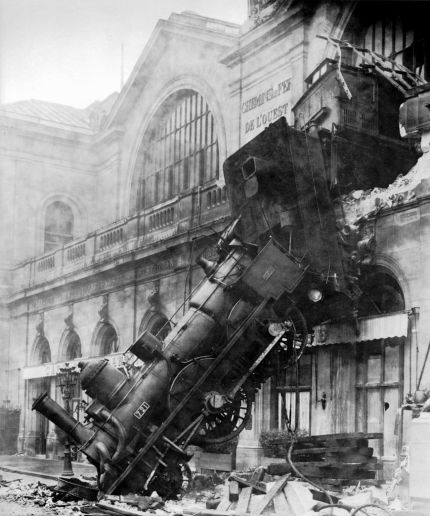
We’re at the Gare Montparnasse.

Torn down in 1969.

Site of this famous 1895 derailment.

train_wreck_at_montparnasse_1895

If a picture is worth a thousand words, I’m up to 1,261.

But we press on…

Because Méliès was about dreams.

And Hugo is about dreams.

les rêves

And Scorsese has been “tapped in” to this magic at least since he portrayed Vincent van Gogh in Akira Kurosawa’s Dreams (Kurosawa-san’s best film).

I must admit…I was a bit confused for awhile.

Something told me Scorsese had transformed himself into Méliès.

It was only later that it all made sense.

Ben Kingsley.

I mean, Scorsese is a great actor (Van Gogh, etc.), but he’s not THAT great!

But I’m jumping ahead…

Sacha Baron Cohen is very good in a somewhat-serious, villain role here.

I fully expected the immensely-talented Cohen to “ham it up” at some point, but he instead gives a very fine, restrained performance which fits like clockwork (sorry) into the viscera of this exquisite film.

But let’s revisit Sir Kingsley.

What a performance!

The loss of a career (Méliès).

The loss of a previous life.

The fragility of celluloid.

All to end up running a pathetic souvenir shop.

Toys.

Very clever, but still…

Such a fall from grace.

Into such obscurity.

I can only compare it to the trajectory of Emmett Miller (which was so artfully documented by my favorite author of all time [Nick Tosches] in my favorite BOOK of all time [Where Dead Voices Gather]).

The speed at which technology moves has the potential to reduce the most eminent personage to mere footnote at breakneck speed.

It was so even a hundred years ago.

And the process has now exponentially accelerated.

But we are coming to understand the trivialization of the recent past.

We are holding tighter to our precious films and recordings.

Because we know that some are lost forever.

Will this vigilance continue uninterrupted?

I doubt it.

But for now we know.

Some of us.

That today’s masterpieces might slip through the cracks into complete nonexistence.

Consider Kurt Schwitters.

The Merzbau.

Bombed by the Allies in 1943.

Es ist nicht mehr.

Into thin air.

But such also is the nature of magic.

Poof!

Skeletons later evoked by Jean Renoir in La Règle du jeu.

Scorsese is a film historian making movies.

And it is a wonderful thing to see.

And hear.

Saint-Saëns’s Danse macabre more than once.

As on a player piano.

With ghost hands.

And the gears of the automaton.

Like the mystery of Conlon Nancarrow’s impossible fugues.

I’m betting Morten Tyldum lifted more than the spirit of gears meshing in Hugo to evoke the majesty of Alan Turing’s bombe in The Imitation Game.

But every film needs a secret weapon (much like Hitchcock relied on the MacGuffin).

And Scorsese’s ace in the hole for Hugo is the Satie-rik, placid visage of Chloë Grace Moretz.

Statuesque as water.

A grin.

A dollar word.

The beret.

And the ubiquitous waltzes as seen through keyholes and the Figure 5 in Gold.

Hugo is the outsider.

Scruffy ruffian.

Meek.  Stealing only enough to survive.  And invent.

But always on the outside looking in.

Below the window (like in Cinema Paradiso).

Ms. Moretz’ world is lit with gas lamps.

And you can almost smell the warm croissants.

[Funny that a film set in Paris should require subtitles FOR PARISIANS]

Assuming you don’t speak English.

Tables are turned.

But Paris draws the cineastes like bees to a hive.

THE hive.

Historically.

And that is just what this is.

History come alive.

But another word about Ms. Moretz.

As I am so wont to say in such situations, she’s not just a pretty face.

Though they are faint glimmers, I see an acting potential (mostly realized) which I haven’t seen in a very long time.

The key is in small gestures.

But really, the key is having Scorsese behind the camera.

It’s symbiotic.

Martin needed Chloë for this picture.

And vice versa.

We get a movie within a movie.

And (believe it or not) even a dream within a dream.

Poe is ringing his bell!

Or bells.

“Lost dream” says Wikipedia.

Yes.

It is as bitter a music as ever rained into Harry Partch’s boot heels.

To have one’s life work melted down for shoes.

Rendered.

To click the stone of Gare Montparnasse.

In an ever-more-sad procession.

Méliès becomes the vieux saltimbanque of which Baudelaire wrote.

Such is life.

We never expected to end up HERE.

Astounding!

-PD

For the Love of a Man [2015)

What a film!

Sometimes I end with that sentiment, but I want to make sure that you take away that message.

This fantastic documentary takes a look at the cult of personality surrounding the biggest star of Tamil cinema:  Rajinikanth.

To paraphrase from one of my favorite films (Genghis Blues), Rajinikanth is like Michael Jordan, Elvis, and John F. Kennedy rolled into one.

If you live in the state of Tamil Nadu.

India.

Yes, we recently touched on Rajasthan, but let’s find Tamil Nadu on a map.

Very southern tip of India.

On the east side.

And here’s where we find Chennai.

[Which seems to be pronounced Chin-ay]

And, of course, Chennai used to be called Madras.

Now that we are caught up on geography, let’s get back to this amazing figure known as Rajini (short for Rajinikanth).

If we are to compare him to other international cinema stars, we might look to Jean-Paul Belmondo.

That great lip-rubbing outlaw of À bout de souffle.

Definitely a smoker.

Smoking those thick-tar Boyards cigarettes.

[Or so I imagine]

And sunglasses.

Rajini must always have his sunglasses.

Cigarettes and sunglasses.

Sounds like a ZZ Top song.

But for Rajinikanth, you need a big, thick mustache.

And you need a certain finesse with those props (the smokes and the shades).

Like Michael Jackson in the “Smooth Criminal” video.

Yeah!

This is India, man!

There’s dancing in the films!

The stars dance!!

And sing!!!

[Of course, don’t tell the generations of voiceover singers that]

But it is well-known.

Mohammed Rafi.  Lata Mangeshkar.

But did Rafi ever sing in Tamil?  Not that I know of.

And Lata?  I have no idea.  But it wasn’t her main language.

So let’s take a step back here…

Tamil.

By “native speakers” (70 million), Tamil is the 20th most spoken language in the world.

That’s ahead of Turkish, Italian, and Thai (just to name a few).

By “total number of speakers” (74 million), Tamil is still the 20th most spoken language in the world.

That’s ahead of Korean, Turkish, and Vietnamese (to name just three).

But what about Tamil cinema?

I’m sure it goes without saying that this is my first venture into writing about this unique slice of the world pie.

Indeed, it’s my first time even really contemplating it to a serious degree.

But back to this Rajinikanth fellow…

He’s ostensibly been the biggest star in Tamil cinema…since the 1970s!

He debuted in 1975.

His first film was in Tamil.

In 1976, he was in four films (only one of which was in Tamil).

In 1977, he was in 15 (!) films (eight being in Tamil).

In 1978, he was in 21 (!!) films (16 in Tamil).

Funny enough, Rajinikanth was not born in Tamil Nadu.

No, rather, he was born in the state of Mysore.

However, this state no longer exists under that name.

And being born in the city of Bangalore (a.k.a. Bengaluru), Rajinikanth would have been born in what is now the state of Karnataka.

65% of Kannadigas (those who live in Karnataka) speak Kannada (not to be confused with Canada).

Oddly, Rajinikanth was born to a Marathi family.

As in, people who speak the Marathi language.

So how does he become the biggest star of the Tamil people?

He indeed spoke Marathi (and Kannada) as a child.

It was only when Rajinikanth came to the Madras Film Institute (well into life) that he finally learned Tamil.

He was 25 when he acted in his first film (a Tamil production).

But I must say, Rajinikanth is a very charismatic figure.

I never finished comparing him to other actors.

Part of me wants to say James Dean, but I think Bruce Lee might be even more apt.

Rajinikanth kicks butt.  But with style!

He has moxie!

And most importantly, he stands up for the little guys.

Having been a bus conductor himself, he has played roles such as that of an auto-rickshaw driver.

And by dint of his sheer magnetism (and an almost Soviet, Trotskyist atmosphere in Tamil Nadu), he has spawned a legion of fans who await his film premieres with what can only be compared to the manic thrall of Beatlemania.

His fans literally scream their lungs out on opening nights…so happy to see their hero in a new picture.

And Rajinikanth makes but one movie every three years now.

If all of this sounds remotely interesting to you, then you absolutely must see For the Love of a Man (which is currently on Netflix in the U.S.).

Director Rinku Kalsy proves herself worlds above many of her contemporaries with this penetrating documentary.

Producer Joyojeet Pal seems to have played a very “hands-on” role as well (as a researcher for this picture).

It’s not always clear where the action is occurring in our film, but it seems that some of it (at least) was filmed in Sholinghur (which is about 67 miles inland from the coastal Chennai).

Then again, we do catch one glimpse of the actual Rajinikanth in the film…and it is in front of his residence in Chennai.

Which is to say, For the Love of a Man is very much about fandom.

And it reminds me of my own devotion to my heroes:  Jean-Luc Godard, Mercury Rev, Bob Dylan…

So I very much identified with the cross-section of Tamil society surveyed in this documentary.

Their devotion to their “leader” is very touching.

Not least, Rajinikanth seems like a very spiritual and magnanimous person.

A really generous human being.

And THAT is what really cements the devotion of his fans.

Any film publication that ripped this movie (Hollywood Reporter) must not have its head on straight.

Anyone in Venice who pooh-poohed this film needs a good spanking.

For the Love of a Man is a masterpiece.

-PD

Alan Partridge: Alpha Papa [2013)

Well, not everything can be a masterpiece 🙂

And while this film (known in the U.S. simply as Alan Partridge) has its moments, it’s a rather lackluster affair overall.

But something kept me watching.

I suppose it was the sheer talent of Steve Coogan.

Bloke’s got a real gift.

But this film just didn’t really do him justice.

24 Hour Party People was much better (if I remember correctly).

At any rate, Alan Partridge is set in Norwich.

Which is in Norfolk.

Which is in East Anglia.

Yes, Mr. Partridge is a pretty shallow gent.

The context, by the way, is that of a radio station.

The film’s action mostly takes place at a radio studio.

It’s a bit of a tense film, but always long on humor.

I must give the director Declan Lowney credit.

There are some quirky bits which work quite well.

And so, perhaps I just haven’t understood this film.

It was relatively enjoyable.

I don’t want an hour and a half of my life back.

It wasn’t that bad.

But something was a bit off.

I must say, the concept was relatively sound.

[no pun intended]

Somehow the execution of the concept was less than stellar.

The acting was all fairly decent.

No doubt that Coogan was the star.

Really, I don’t know quite what to say about this one.

I wouldn’t recommend it as a life-changing film.

It’s relatively light and enjoyable, but there are a good many guns in the film.

The premise is, as stated, quite tense.

If you work in a radio station, you might find certain parts funnier than I did.

At any rate, it was great to know that Steve Coogan’s still got it.

I will be looking out for more of his wonderful performances in the future.

Cheerio!

-PD

Filmistaan [2013)

I consider it an auspicious sign that my survey of Indian cinema begins in earnest with the masterpiece Filmistaan.

Do not mistake this piece of cinema for a half-baked idea.

Do not even attempt to lower it by calling it a comedy.

And not least, do not think only of India.

I wanted to come up with a catchy pigeonhole.

Indian Subcontinent.

The Subcontinent.

But I have too much respect for the great traditions of Bollywood (and Lollywood) to do such a thing.

And so this is very much an Indian film.

India.

And it is very much a comedy.

So funny!

But it is touching in a way to which few films can ever aspire.

Filmistaan, like Roberto Benigni’s magnum opus La vita è bella, takes on a very serious subject with the best weapon of all:  humor.

But instead of the Holocaust, we get the Partition.

And yet, Filmistaan is not some laborious period piece.

[leave that to the artless Spielbergs]

No, our film addresses the tension between India and Pakistan in the most deft, feather-light manner imaginable.

And for this we have to thank a new auteur on the world stage:  Nitin Kakkar.

I say “new” because Mr. Kakkar has not been graced with the honor of his own Wikipedia page in English yet.

Well, he is wholly deserving of that honor (based on Filmistaan alone).

But Mr. Kakkar had to have magical actors to pull this off.

Luckily for him, he did!

Sharib Hashmi is undoubtedly the star of this picture.

His performance as Sunny goes from the highest highs of emotion to the lowest lows.

It is truly remarkable.

Mr. Hashmi is about one month older than me.

40 years old.

Perhaps that’s why I identified with his youthful optimism and passionate devotion to cinema.

But to understand our film, we must first locate Rajasthan on a map.

It is the biggest state in India.

It is northwest.

And it borders Pakistan.

To understand Rajasthan, we must comprehend the Thar Desert.

Most of the Thar Desert is in Rajasthan, but it extends somewhat into Pakistan.

These are all important details in understanding our film.

Rajasthan is arid.

Like the American Southwest, it’s a good place to get lost…or kidnapped.

But friends are to be found in the most unlikely places.

And the friendship of shared interest, such as two cinema devotees, knows no borders.

For Mr. Hashmi, the brilliance of his performance depends on the artful support he receives from fellow-actor Inaamulhaq.

But let’s examine the divide between India and Pakistan for a moment.

It is a fact that a man from Peshawar (if he speaks Urdu) can communicate with a man from Delhi (if he speaks Hindi).

Peshawar, of course, is in Pakistan.

Indeed, it’s so far into Pakistan that it’s almost in Afghanistan.

Delhi, of course, is in India.

It is in the north-central part of the country.

It is, further, not essential that the two talkers hypothesized above be men.

The salient detail is that Hindi and Urdu are essentially the same language (in their spoken forms).

This is vital to understanding Filmistaan.

But continuing, the two languages could not look more different once they are written down.

[Which is to say, the two hypothesized men might be at loggerheads were they forced to communicate with pen and paper]

Urdu looks similar to its written forebear Farsi (the language of Iran) [which is itself a descendent of Arabic script].

To put it quite simply, a neophyte like myself would probably have a difficult time telling the difference between Urdu, Persian (Farsi), and Arabic.

Hindi is in the wholly different Devanagari script.

You will not confuse written Urdu and Hindi.

It’s at least as obvious as Picasso to Pollock (if not Warhol to Rembrandt).

But enough analogies.

Why should you watch Filmistaan?

Well, for one…it’s currently on Netflix.

Yes, ever since I have joined the streaming service, I have ventured to be a more “worthwhile” film critic by giving you relatively-spoiler-free reviews of current titles to be found on the U.S. version of the site.

But that’s only the beginning.

Yes, there are wonderful performances from Kumud Mishra and Gopal Dutt (as well as a plethora of fine supporting actors).

But the real reason is that Filmistaan expresses the sublime.

The context is terrorism.

The context is border tension.

Indeed, on the Indian Subcontinent, the context is two nuclear states.

Pakistan and India.

But the context goes back.

To Jinnah and Nehru.

And the threads bind.

Cricket.  Cinema.  Music.

There is an excellent example in Filmistaan which illustrates the situation.

Dilip Kumar.

Now 94 years old.

Like my hypothetical man from earlier, born in Peshawar.

Then a part of “Pre-Independence India”.

Now a part of Pakistan.

Bordering Afghanistan.

In Filmistaan, Inaamulhaq knows him as Sir Yusuf.

Sunny knows him as Dilip.

Dilip Kumar was born Muhammad Yusuf Khan in Peshawar in 1922.

Sir Yusuf.

Dilip Kumar.

Same person.

It’s like the World Wars.

fenêtre in French

das Fenster in German

window.

/\

fenêtre /\ Fenster

But when you look through a window (or a border), everything can look backwards.

You’re so close, in reality.

But you’re reading the word as if in a mirror.

Nitin Kakkar directed a masterpiece with Filmistaan because he put his heart and soul into evoking peace.

There are no winners in a nuclear war.

And peace is a rare commodity on the world stage.

Geopolitics…

But we must reach out that hand.

And shake it.

I congratulate Nitin Kakkar and Sharib Hashmi for their dedication.

It is evident.

Though I speak neither Hindi nor Urdu, I was able to watch.

And understand.

I needed the subtitles.

But sublime emotions may be mutually intelligible across cultures.

What a film!

-PD